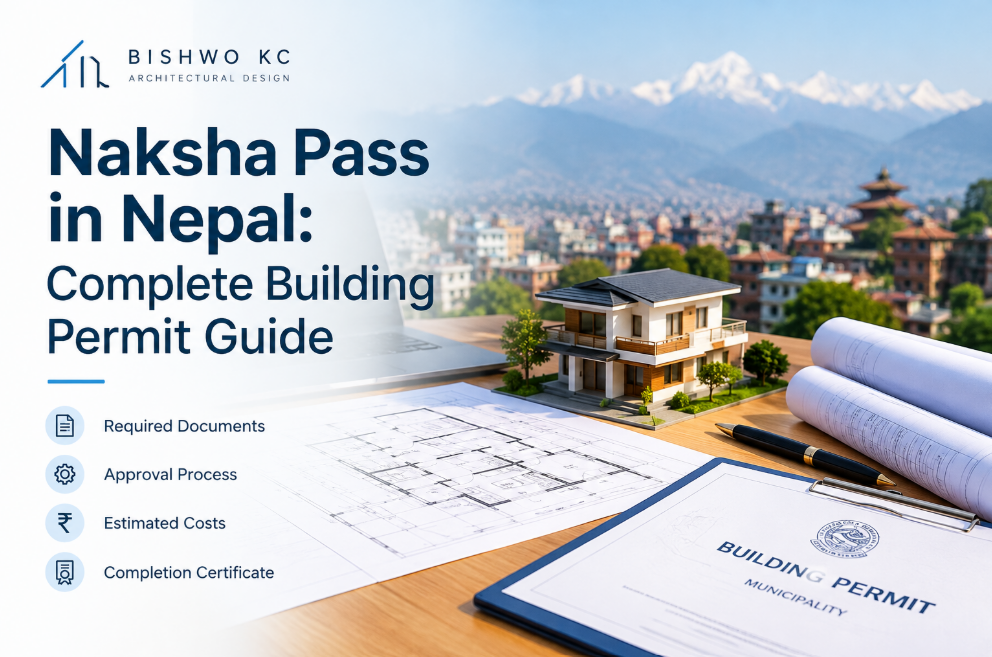
Planning to build a house in Nepal? Before starting construction, one of the most important steps is understanding the Naksha Pass process in Nepal. Naksha Pass is the common local term for obtaining municipal approval of building plans and permission to construct a building according to applicable regulations.
Whether you are planning a residential house, a rental property, or a commercial building, the approval process can involve land-document verification, architectural and structural drawings, technical review, site verification, and payment of applicable municipal fees.
The exact procedure depends on the municipality where your land is located. This guide explains the key stages, Naksha Pass documents, potential costs, and the importance of obtaining approval before construction begins.
If you are planning a new house, reviewing your design and documentation with an experienced professional can help you prepare for the municipal submission process.
What Is Naksha Pass in Nepal?
Naksha Pass in Nepal refers to the process of obtaining approval for building drawings from the relevant local government before constructing or making certain changes to a building.
The approved plans help establish whether the proposed building complies with applicable municipal requirements, land-use restrictions, setbacks, building standards, and other relevant conditions.
Under the Local Government Operation Act, 2074, municipalities and rural municipalities have responsibilities relating to building construction permissions. Section 27 addresses construction without approval, subject to applicable exceptions, while subsequent provisions address applications and the approval process.
You can read the Local Government Operation Act, 2074, published by the Nepal Law Commission for the legal framework.
In practical terms, Naksha Pass involves preparing the required plans and supporting documents, submitting them to the relevant authority, responding to technical or administrative requirements, and obtaining the applicable building permit.
Why Is Naksha Pass Important Before Construction?
Obtaining the required building approval is an important part of responsible construction planning.
1. Compliance with municipal requirements
Municipalities may regulate building height, setbacks, road access, plot coverage, floor area, and other planning considerations. Your design needs to satisfy the standards applicable to your site and project.
2. Better coordination of architectural and structural plans
Architectural drawings explain the layout, room arrangements, elevations, and other design features. Structural drawings address the building's structural system and related engineering requirements.
Coordinating these documents before submission can reduce inconsistencies that may require corrections.
3. Clearer construction planning
An approved design provides a reference for the intended building configuration. It also helps the owner, architect, engineer, and construction team work from coordinated documentation.
4. Support for the building completion process
Depending on local requirements, a building completion certificate or equivalent municipal documentation may be required after construction. The completed building may need to be inspected against the approved drawings and applicable conditions.
Who Needs Naksha Pass in Nepal?
Whether approval is required depends on the nature of the work and the rules of the relevant local authority.
You should consult your municipality before proceeding if you plan to:
-
Construct a new residential house.
-
Build a multi-storey or rental building.
-
Construct a commercial or institutional property.
-
Rebuild an existing structure.
-
Add floors or extend a building.
-
Make changes to an approved building plan.
-
Carry out other construction work covered by municipal building regulations.
The Local Government Operation Act describes building construction broadly, including new construction, reconstruction, additional floors, and certain alterations. However, applicable exceptions and procedures must be checked with the local authority.
Do not assume that a small extension or modification is automatically exempt from approval.
Naksha Pass Documents: What Do You Need?
The documents required for Naksha Pass vary by municipality, project type, land ownership situation, and the type of approval being requested.
Kathmandu Metropolitan City's official Electronic Building Permit System (eBPS) lists several documents associated with its building-permit application process.
Use the following checklist as a preparation guide, not as a universal list for every municipality.
1. Land ownership documents
Prepare the applicable documents establishing ownership or the legal basis for using the land. These may include:
-
Land ownership certificate or Lalpurja.
-
Cadastral extract or cadastral map.
-
Relevant land or plot details.
-
Lease or other supporting documents where applicable.
The municipality may require additional verification if the land has multiple owners, a boundary discrepancy, or another ownership-related issue.
2. Owner identification documents
The application may require the owner's citizenship or another accepted identity document. For a company-owned property, company registration or other relevant organizational documents may be required.
3. Architectural drawings
Architectural plans generally communicate the proposed building layout and design. Depending on the project and municipality, the submission may include:
-
Site or plot plan.
-
Floor plans.
-
Building elevations.
-
Building sections.
-
Roof plan.
-
Setback and site information.
-
Other drawings required by the municipality.
The required drawing format, number of copies, signatures, and submission method should be confirmed before filing the application.
4. Structural drawings and calculations
Structural documentation may be necessary to demonstrate how the proposed building is designed to resist the relevant loads and meet applicable structural requirements.
The scope depends on the building and local submission rules. Ask the responsible structural engineer which calculations, drawings, and certifications are required.
5. Tax payment and supporting records
Municipalities may request proof of relevant tax payments or other administrative records. The exact requirements should be confirmed with the appropriate ward office or municipal building-permit department.
6. Professional certification
The building plans may need to be prepared, certified, or submitted by an architect, engineer, designer, or consultant who satisfies the applicable registration and municipal requirements.
Kathmandu Metropolitan City maintains its own eBPS system and designer-related procedures. Requirements in another municipality may differ.
Official reference: Review the Kathmandu Metropolitan City eBPS building-permit guidance and building bylaws and reference documents.
Before submitting your application, confirm the current checklist directly with the municipality where the property is located.
Naksha Pass Process in Nepal: Step-by-Step Guide
The Naksha Pass process in Nepal generally involves preparing the application, submitting the drawings and supporting records, undergoing municipal review, and receiving the relevant approval. The exact order and terminology can vary between local authorities.
Step 1: Identify the responsible municipality
First, determine which municipality or rural municipality has jurisdiction over your property.
A property in Kathmandu Metropolitan City may follow its eBPS procedures, while a property in Lalitpur, Bhaktapur, or another municipality may follow a different system.
Confirm the relevant ward office, building-permit department, application portal, and current submission requirements.
Step 2: Verify the land and site information
Review the land ownership records, plot boundaries, access road, and other relevant site information before finalizing the building design.
Where necessary, arrange a site survey or professional assessment to identify discrepancies between the available records and actual site conditions.
Resolving these issues early can help prevent delays during application review.
Step 3: Consult an architect or qualified design professional
The next step is to develop a design that responds to the plot, the intended use of the building, the owner's requirements, and applicable regulations.
A professional may help assess:
-
Plot dimensions and orientation.
-
Building setbacks and permissible development.
-
Floor plans and circulation.
-
Natural light and ventilation.
-
Parking and access.
-
Structural coordination.
-
Relevant municipal building standards.
When selecting an architect in Nepal, confirm that the professional meets the registration and licensing requirements applicable to your project and municipality.
You can review architectural design and planning services to understand the kinds of design and documentation support an architecture practice may offer.
Step 4: Prepare the architectural and structural drawings
Once the site and project requirements are understood, the required drawings and technical documents can be prepared.
Architectural and structural documentation should be coordinated so that the submitted plans represent a consistent building proposal.
Before submission, check dimensions, plot boundaries, setbacks, floor arrangements, building height, and other information against the applicable municipal requirements.
Step 5: Submit the application and supporting documents
Submit the required application, drawings, ownership records, identification documents, and other supporting materials through the municipality's designated process.
In Kathmandu Metropolitan City, the official eBPS guidance describes a process involving electronic submission and municipal and ward-level review.
Keep copies of the submitted documents and retain the application or reference number for follow-up.
Step 6: Respond to municipal review and site verification
The municipal authority may examine the submitted plans and supporting documents. Site verification, notices, local inquiries, or requests for clarification may form part of the process, depending on the applicable procedure.
If corrections are requested, coordinate with the responsible design professional to address them and submit revised documents as instructed.
A submission should not be treated as approved merely because it has been received or registered.
Step 7: Receive the building permit
Once the application satisfies the applicable requirements and the relevant authority grants approval, the owner can receive the appropriate building permit and approved drawings.
Review the approval carefully. Confirm the approved design, any conditions attached to the permit, and the permitted scope of construction.
Keep the approved documents accessible throughout construction.
Step 8: Construct according to the approved plans
Construction should follow the approved drawings and applicable building requirements.
If a proposed change affects the approved design, ask the municipality and the responsible professional whether revised approval is required before implementing that change.
Avoid assuming that a change is acceptable simply because it appears minor.
Step 9: Apply for building completion documentation
After construction, follow the municipality's procedure for inspection and the applicable completion certificate or equivalent documentation.
The authority may inspect the completed building and compare it with the approved plans and relevant conditions. Any discrepancies may need to be addressed before the completion process can be finalized.
Naksha Pass Price in Nepal: What Does It Cost?
The Naksha Pass price is not a single fixed amount throughout Nepal. The total cost depends on the municipality, the type and size of the building, the applicable fee schedule, and the professional services required for the project.
For accurate budgeting, separate the municipal charges from the design and documentation costs.
Main cost components
| Cost component | What it covers |
|---|---|
| Municipal permit fee | Building approval charges calculated according to the applicable local rules |
| Architectural design fee | Design development and architectural drawings |
| Structural design fee | Structural drawings, calculations, and related engineering work |
| Survey and site assessment | Surveying or other site-related professional services, where needed |
| Documentation and revisions | Additional drawings, corrections, or other services according to the agreed scope |
| Completion-related charges | Applicable inspection, completion, or documentation fees |
Not every project will incur every cost listed above. Some services may be included in a professional's package, while others may be billed separately.
How to calculate your likely Naksha Pass cost
Use this practical approach:
-
Identify the municipality responsible for your property.
-
Obtain its current building-permit fee schedule.
-
Confirm how the fee is calculated for your building category and approved area.
-
Ask the design professional for a written quotation showing the scope of services.
-
Confirm whether structural design, revisions, submission assistance, site visits, and completion documentation are included.
-
Keep a contingency for additional requirements that may arise during the process.
Kathmandu Metropolitan City's official eBPS building-permit page publishes information about fees and the permit procedure. However, published fee information must be checked against the latest applicable municipal schedule before relying on it for a current quotation.
Important: Do not use a fee quoted for Kathmandu Metropolitan City as the price for a property in another municipality. Always obtain confirmation from the local authority.
How Long Does Naksha Pass Take in Nepal?
The time required for Naksha Pass depends on the municipality's procedure, the completeness of the application, the type of project, site conditions, and whether objections or corrections arise.
Kathmandu Metropolitan City's published eBPS guidance describes a sequence of submission, ward-level review, notices, local inquiry, and permit issuance. It also describes a separate process for obtaining a building completion certificate.
These published timelines should not be interpreted as a guarantee for every project or as the processing time for all municipalities.
You can help prepare for a smoother process by:
-
Collecting the required documents before applying.
-
Checking land records and site details for inconsistencies.
-
Ensuring that drawings are complete and coordinated.
-
Responding promptly to official requests.
-
Confirming whether notices, inspections, or additional approvals are required.
Ask the responsible municipal office for the current expected timeline for your particular application.
What Is a Naksha Pass Certificate?
A Naksha Pass certificate commonly refers to the building-permit certificate or approval documentation issued by the relevant local authority after the building plans and application have been approved.
The exact document name, format, and approval stages may differ by municipality.
The approval documents should be kept safely because they provide a reference for the authorized construction. They may also be relevant during inspections, applications for revisions, or the building completion process.
Is a building permit the same as a completion certificate?
No. They serve different purposes.
A building permit relates to authorization to construct according to the approved proposal. A building completion certificate or equivalent document relates to the municipality's completion procedure after construction.
Depending on the applicable rules, the authority may need to inspect the completed building and verify compliance with the approved plans before issuing completion documentation.
Do not assume that receiving a building permit automatically means the completed building has been certified.
Common Mistakes to Avoid During Naksha Pass
1. Starting construction before approval
Starting work without obtaining the required permission can create compliance problems. Confirm the applicable requirements before beginning construction.
2. Submitting incomplete documents
Missing ownership records, inconsistent plot details, incomplete drawings, or absent supporting documents may require additional submissions.
Use the municipality's current checklist rather than relying only on a general online list.
3. Ignoring setbacks and other building standards
A design that does not satisfy applicable requirements may need to be revised. Check the relevant standards before finalizing the plans.
4. Making changes without checking approval requirements
Adding a floor, changing the building layout, or modifying the approved design can affect compliance. Ask the relevant authority whether a revised submission is needed.
5. Focusing only on municipal fees
The permit fee is only one part of the project budget. Architectural design, structural engineering, site assessment, and other professional services may add to the total cost.
6. Choosing a professional without checking qualifications
Before hiring an architect or designer, confirm the person's qualifications, relevant registration, experience with the applicable municipal process, and the scope of services being offered.
7. Forgetting the completion process
Plan for the required inspection and completion documentation as part of the overall construction project, rather than treating it as an afterthought.
How Can an Architecture Firm in Nepal Help With Naksha Pass?
Working with an architecture firm in Nepal can help coordinate the design, technical documentation, and administrative preparation involved in a building-permit application.
Depending on the agreed scope and applicable professional requirements, the service may include:
-
Site assessment and design consultation.
-
Architectural planning and floor-plan development.
-
Preparation of municipal submission drawings.
-
Coordination with structural engineers.
-
Review of applicable building requirements.
-
Assistance with application documentation.
-
Coordination of corrections requested during review.
-
Support with the building completion process.
The exact responsibilities should be agreed upon in writing. Municipal authorities remain responsible for reviewing applications and granting approvals; hiring a professional does not guarantee that a permit will be issued.
Planning a house in Kathmandu or elsewhere in Nepal?
Bishwo K.C. Architectural Design provides architectural design and planning services, including municipal documentation support as part of the agreed project scope.
If you are preparing to build a house, discuss your plot, proposed building, requirements, and location with the team before finalizing your design.
Visit the architectural services page or contact Bishwo KC for an architectural consultation.
Conclusion
Naksha Pass is an important part of planning construction in Nepal. Before beginning work, identify the responsible municipality, confirm the applicable regulations, prepare the required land and building documents, and follow the official application process.
The documents, fees, and timelines can vary, so verify current requirements directly with your local authority rather than relying on a general estimate.
With proper preparation and coordinated architectural and structural documentation, property owners can approach the building-permit process with a clearer understanding of the requirements and the next steps involved.
FAQs
Can I apply for Naksha Pass online in Nepal?
Some municipalities provide electronic building-permit systems. Kathmandu Metropolitan City operates an eBPS platform. Check whether your local authority accepts online applications and what documents must be submitted.
Can I build a house without Naksha Pass?
Building approval is generally required where applicable under local law. The Local Government Operation Act, 2074, addresses construction without approval, subject to applicable exceptions. Confirm the rules for your property with the relevant municipality before beginning work.
Does Naksha Pass expire?
The validity of a building permit and the procedure for extending its validity depend on the applicable municipal rules and the conditions of approval. Ask the issuing authority about the construction period, extension procedure, and any additional charges.
What should I do if my building design changes after approval?
Consult the municipality and your design professional before making changes. Depending on the nature of the modification, a revised drawing or additional approval may be necessary.
Is a structural drawing required for Naksha Pass?
Structural drawings and related technical documents may be required depending on the building, the municipality, and the applicable standards. Confirm the exact requirements with the responsible authority and structural engineer.
How can I check the Naksha Pass price for my property?
Contact the municipality where the property is located and request its current fee schedule. Ask your architect or designer for a separate quotation covering professional services, drawings, and any additional work.
What happens after I receive the Naksha Pass certificate?
Review the approval conditions, retain the approved drawings, and construct according to the authorized plans. After construction, follow the municipality's applicable inspection and building-completion procedure.